The Philosophy Matters More Than the Costume
A robe can be comfortable.
A sweater can be comfortable.
A suit can be comfortable, assuming it fits properly and was not designed by someone who secretly hates shoulders.
But none of them are the philosophy.
The robe is not the point.
The bowling is not the point.
The White Russian is not the point.
The beard, the sandals, the sunglasses, the clever quote, the spiritual label, the business title, the aesthetic, the vibe, the costume, the whole little character people sometimes build around themselves.
None of that is the point.
It can be fun.
It can be useful.
It can be part of how something gets remembered.
But the wrappings are not the thing.
The thing is underneath.
The ideas.
The beliefs.
The choices.
The actions.
The way you actually move through life when things go sideways, people get weird, plans fall apart, and your nervous system starts looking for the nearest emergency exit.
That is where the philosophy lives.
Not in the outfit.
Not in the theatricality.
Not in the branding.
In what you actually practice.
The costume can help, but it can also distract
I like personality.
I like style.
I like a good visual hook.
I like the fact that a robe, a rug, a bowling metaphor, and a few well-placed Dude-ish references can make a practical idea feel more human and less like it came from a corporate training manual called Optimizing Inner Calm for Quarterly Outcomes.
That is part of the fun.
The problem starts when the costume becomes the whole identity.
People do this everywhere.
In spirituality, someone starts dressing like an enlightened fog machine and speaking only in soft riddles.
In business, someone becomes a walking LinkedIn profile with shoes.
In wellness, someone turns every cup of tea into a sacred transformational portal.
In personal development, someone discovers three techniques and immediately starts acting like they have returned from a mountaintop with the final operating manual for humanity.
In hypnosis and NLP, people sometimes get so wrapped up in the performance, the language, the mysterious persona, the pendulum jokes, the stage stereotypes, or the “look how powerful I am” nonsense that they forget the real point is helping people change in useful ways.
And yes, in Dude-ish territory, someone can easily mistake the bathrobe for the philosophy.
But dressing like The Dude does not make you free.
Just like wearing a suit does not make you responsible.
Just like owning crystals does not make you wise.
Just like saying “I’m very grounded” while being one delayed email away from emotional combustion does not necessarily make it true.
The outer thing can point toward something.
But it cannot replace living it.
The Dude is useful because he is not trying so hard to be useful
Part of what makes The Dude work as a cultural reference is that he is not trying to be a guru.
He is not standing on a stage with a headset mic telling everyone how to manifest a better bowling average.
He is not selling enlightenment in twelve payments.
He is not pretending to be polished.
He is just this strange, relaxed, frequently confused human being trying to get through a deeply odd chain of events while holding onto some basic decency.
That is useful.
Not because we should all copy him.
Please do not build your whole life around copying a fictional character who struggles with basic adult logistics.
That would be missing the point.
The useful part is the underlying attitude.
Take life seriously enough to care, but not so seriously that every inconvenience becomes a personal apocalypse.
Stand up for what matters, but do not become a rigid little tyrant about everything.
Enjoy simple pleasures.
Support people in your orbit.
Keep rolling through the strikes and gutters.
Do not let the squares harsh your mellow.
And maybe, most importantly, do not become an asshole.
That last one is not complicated.
It is just surprisingly practical.
A laid-back attitude is not the same as laziness
This is one of the big misunderstandings.
Some people hear “take it easy” and think it means do nothing.
Avoid responsibility.
Drift.
Ignore problems.
Let everyone else carry the load.
Pretend you are above caring because caring would require effort.
That is not philosophy.
That is checking out.
A laid-back but not lazy attitude is something else.
It means you still show up.
You still do what needs doing.
You still pay attention to the people around you.
You still stand up for the things you believe in.
You still take action.
But you do not turn every action into a stress festival.
You do not grip life so tightly that your hands go numb.
You do not treat every mistake like evidence in the trial of your entire identity.
You do not need to win every argument, prove every point, respond to every slight, control every outcome, or carry every stray bit of chaos that wanders into the room.
You act.
You adjust.
You breathe.
You keep your mind limber.
That is not laziness.
That is a more intelligent use of effort.
Daoism, Dudeism, and not trying to force the river uphill
There are parts of Dudeism that overlap nicely with Daoist ideas.
Not in a “let’s pretend we are ancient sages now” way.
More in the very practical sense that forcing life constantly does not usually make life go better.
There is an old idea in Daoist philosophy often described as going with the natural flow of things. Not giving up. Not becoming passive. More like learning when to act, when to wait, when to soften, when to redirect, and when to stop trying to hammer reality into the exact shape your anxious mind demanded.
That feels useful.
Because a lot of people spend their lives trying to force the river uphill.
They force conversations.
Force productivity.
Force certainty.
Force identities.
Force themselves into roles they do not even like.
Force ceremonies, careers, relationships, beliefs, clothing, hobbies, and personalities into shapes that make sense to everyone except the person living inside them.
That is exhausting.
And it is not necessary.
Sometimes the more useful question is not, “How do I force this to work?”
Sometimes it is:
“What is the natural next move here?”
“What am I making harder than it needs to be?”
“What would happen if I stopped performing and started paying attention?”
Those are dangerous questions in the best way.
They can loosen things.
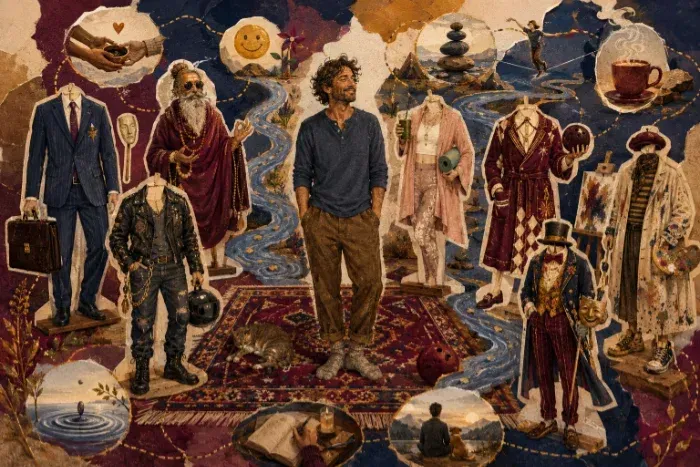
The costumes people wear every day
Most costumes are not actual costumes.
They are roles.
The always-professional one.
The always-funny one.
The tough one.
The spiritual one.
The rebellious one.
The successful one.
The chill one who is secretly furious.
The responsible one who cannot admit they are tired.
The helpful one who says yes while resenting everyone.
The intelligent one who cannot risk being wrong.
The carefree one who is actually avoiding the hard stuff.
The polished one who is quietly falling apart.
People wear these things because they worked at some point.
A role gets rewarded.
An identity keeps you safe.
A persona helps you belong.
A look tells people how to treat you.
And then, without noticing, you start serving the costume instead of living your life.
That is when it gets weird.
A suit can be a useful costume.
A robe can be a useful costume.
A professional title can be useful.
A spiritual identity can be useful.
A creative persona can be useful.
But if you cannot take it off, it is not style anymore.
It is a trap with accessories.
The philosophy is in the small choices
You do not need to look like The Dude to practice something useful.
You do not need to quote the movie.
You do not need to bowl.
You do not need to wear a robe.
You do not need to drink anything in particular.
You do not even need to like the film, although I may quietly wonder about you for a moment and then respect your opinion, because that is the decent thing to do.
The philosophy shows up in ordinary choices.
When someone annoys you and you pause before replying.
When a plan falls apart and you adjust instead of spiraling.
When you notice a small pleasure and let yourself enjoy it.
When you are honest without being cruel.
When you choose not to make a bad mood everyone else’s weather.
When you stand up for yourself without turning into a raging walrus of righteousness.
When you stop pretending to be someone you are not just because that version is easier for other people to understand.
That is where it lives.
Not in the costume.
In the pattern.
In the practice.
In the way you come back to yourself.
Walter, Donny, Marty, and being a person
One of the funny things about The Big Lebowski is that beneath all the chaos, yelling, confusion, bowling, threats, mistaken identity, and general weirdness, there are these little human moments.
Walter is often a disaster with volume control issues, but he is loyal in his own deeply complicated way.
Donny is often ignored or interrupted, but he is part of the group, part of the rhythm, part of the strange little bowling-family ecosystem.
And The Dude shows up for his landlord Marty’s dance performance, which is objectively a very specific kind of support.
That kind of detail matters to me.
Not because we need to turn every film moment into a moral lesson.
That gets old fast.
But because it reminds us that being laid-back does not mean not caring.
Sometimes it means caring in quiet, odd, imperfect ways.
Showing up.
Being there.
Letting people be strange.
Letting yourself be strange.
Making room for someone else’s thing, even if that thing is a dance cycle you may or may not fully understand.
That is not laziness.
That is a kind of openness.
And openness is underrated.
Be yourself, not a copy
This is probably the biggest point.
The goal is not to become The Dude.
The goal is not to become anyone else.
The goal is not to swap one costume for another and call it freedom.
You do not need to become more robe-like.
You do not need to become more spiritual-looking.
You do not need to become more quirky, more polished, more rebellious, more chill, more anything just because someone else makes it look good.
The useful thing is to notice what helps you become more yourself.
More honest.
More relaxed.
More responsible in a way that does not crush you.
More able to enjoy your life.
More willing to stand up when needed.
More able to let go when the thing is not yours to carry.
More able to respond instead of react.
More able to define your own rug.
That is the point.
You can borrow metaphors.
You can enjoy references.
You can use costumes for fun.
But do not let the costume do the living for you.
No guru robe required
I am not interested in pretending to be some perfectly peaceful expert who has transcended all human nonsense.
That guy sounds unbearable.
Also fictional.
I am interested in useful philosophy.
The kind that works in traffic.
The kind that works after a disappointing phone call.
The kind that works when you are tired, annoyed, behind, overthinking, under-caffeinated, or trying not to answer a message with the emotional precision of a thrown shoe.
The kind that says:
Take it easy, but do not check out.
Care, but do not panic.
Be kind, but not cowardly.
Stay flexible, but not flimsy.
Enjoy the small things.
Do not be an asshole.
Keep rolling.
That is enough to work with.
And if you want to wear a robe while doing it, fine.
If you want to wear a suit, fine.
If you want to wear jeans, bowling shoes, a hoodie, a purple shirt, or the outfit of a Time Lord attending a wedding, also fine.
The costume is allowed to be fun.
It just does not get to be the whole thing.
Because the philosophy matters more.
And the philosophy, if it is worth anything, should help you live.
Not just look the part.