Your Ceremony Does Not Have to Be Stiff to Be Meaningful
Somewhere along the way, a lot of people got the idea that a ceremony has to be stiff to count.
The serious voice.
The formal wording.
The correct order.
The right clothes.
The expected music.
The required rituals.
The part where everyone stands exactly where they are supposed to stand, smiles at the correct time, cries when socially appropriate, and pretends the whole thing did not feel like a rehearsal for a tradition they never actually chose.
Now, let me be clear.
If you love the traditional version, fantastic.
If you want the church, the formal clothes, the classic music, the old wording, the aisle, the candles, the readings, the unity ceremony, the whole beautiful structure of it, I am genuinely all for it.
Some people love that.
Some people find deep meaning in tradition.
Some families connect through it. Some couples want it. Some ceremonies feel better because they are connected to something older, something familiar, something that has carried meaning for generations.
That can be beautiful.
The problem is not tradition.
The problem is obligation wearing tradition’s clothes.
Meaning does not require stiffness
A ceremony can be serious without being stiff.
It can be meaningful without being formal.
It can be sacred without being churchy.
It can be emotional without being miserable.
It can be funny without becoming a joke.
It can be simple without being shallow.
It can be weird, personal, quiet, colorful, traditional, nontraditional, spiritual, secular, playful, solemn, loud, private, public, beachy, backyardy, fancy, barefoot, suited, costumed, or something nobody else quite understands.
And it can still matter.
That is the point.
A ceremony is not meaningful because it checks every box on a list someone else made.
It is meaningful because it marks something real.
A commitment.
A goodbye.
A beginning.
A change.
A promise.
A memory.
A shared decision.
A moment where life says, “This matters,” and people pause long enough to agree.
That pause can happen in a cathedral.
It can happen on a beach.
It can happen in a backyard with folding chairs and one uncle who keeps asking where the snacks are.
The setting is not the meaning.
The meaning is the meaning.
Your ceremony should feel like yours
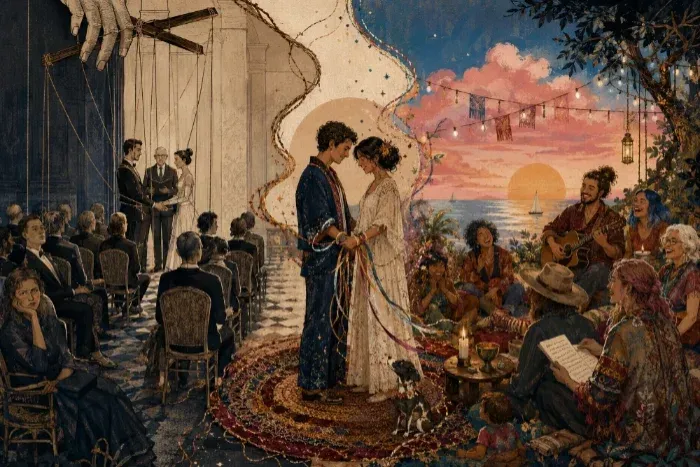
When my wife and I got married, we did not want the fully traditional church-and-formality version.
We still wanted some of the fun parts. The dress. The suit. The sense of occasion. The moment.
But we wanted it to feel like us.
So we got married on a beach.
My wife picked a dress she really liked, with its own theme and personality. I put together an outfit loosely inspired by something the Eleventh Doctor might have worn to a wedding. Not exact, because time, money, and reality enjoy having opinions, but close enough that it made me happy.
We wrote our own vows.
We kept religion out of it.
We chose music that actually meant something to us, not just the standard wedding tracks people use because someone once decided those were the official sounds of commitment.
And the vows were not the old-school, male-dominated, “one person submits to the other” kind of thing.
That was not us.
We wanted something more equal. More honest. More about sharing existence together. More about choosing each other, not performing a script about what marriage is supposed to look like.
That mattered.
Not because everyone else would have done it that way.
Because we did.
The ceremony is not supposed to move you around like a marionette
I have seen how much pressure weddings and ceremonies can put on people.
The day is supposedly about love, commitment, family, memory, meaning, and celebration.
Then somehow it turns into a production schedule with flowers.
Go here.
Stand there.
Smile now.
Take the picture.
Do the dance.
Cut the cake.
Kiss again because someone tapped a glass.
Now the bouquet.
Now the garter.
Now the dollar dance.
Now pose with this person.
Now say hello to that table.
Now hurry up because the photographer needs you outside before the light changes.
And if you get five minutes to sit down and talk with the person you just promised to share your life with, good for you.
If you actually get to eat the meal you paid for, you are already ahead of where I was.
I did not even get a slice of my own cake.
That is not bitterness, by the way. Mostly.
It is just funny in that “well, that happened” kind of way.
But it also points to something real.
Sometimes ceremonies, especially weddings, become less about the people at the center and more about satisfying the expectations orbiting around them.
Guests want this.
Family expects that.
Tradition says this comes next.
Someone saw something at another wedding and now apparently it is mandatory.
Before long, the couple is less like the director of their own day and more like two people trapped in a movie everyone else is trying to produce.
That seems backwards.
Tradition should be chosen, not imposed
Traditions can be wonderful when they are chosen.
They can give shape to something that feels too big for ordinary words.
They can connect generations.
They can make a moment feel rooted.
A handfasting can be beautiful if it speaks to you.
A unity candle can be beautiful if the symbolism matters.
Personal vows can be beautiful if they come from a relaxed place of love rather than pressure to perform.
Storytelling can be beautiful.
Music can be beautiful.
Readings can be beautiful.
A quiet moment of remembrance can be beautiful.
A shared drink, a symbolic object, a blessing, a ring warming, a candle, a song, a poem, a joke, a family member stepping forward, a dog walking down the aisle with absolutely no concern for human dignity.
All of it can work.
But not because you are supposed to do it.
Because it means something to you.
That is the difference.
Doing something because it resonates is meaning.
Doing something because you are afraid someone will judge you if you do not is performance.
And performance can get heavy fast.
Humor belongs where it belongs
Some people want a ceremony that is elegant, quiet, and deeply emotional.
Some people want a few laughs.
Some people want the whole thing to feel like a warm gathering where people cry, laugh, and then argue about dessert in a healthy family way.
Humor can belong in a ceremony if humor belongs to the people.
If you are funny together, let that show.
If your relationship includes teasing, warmth, weird references, shared jokes, and laughing through chaos, then a ceremony that removes all humor can feel oddly fake.
Like someone took the real people out and replaced them with rental versions.
That does not mean turning a wedding into a stand-up set or a memorial into open mic night.
It means allowing the full humanity of the moment.
Love is serious.
It is also frequently ridiculous.
Grief is serious.
It can still include laughter.
Commitment is serious.
It does not need to be joyless.
One of my least favorite ideas is that the more meaningful something is, the more miserable everyone has to look while doing it.
I do not want that for my own funeral.
When the time comes, I do not want some stiff, black-clothed, miserable affair where everyone stands around pretending sadness is the only respectful emotion.
I would rather people wear bright colors. Purple would not be a bad choice.
I would rather they remember the good times, the funny stuff, the strange little moments, the things that made life feel like life.
Maybe they watch one of my favorite movies.
Maybe there is some recorded message from me.
Maybe, if I am feeling especially on brand, I leave them with an impromptu hypnosis session from beyond the grave.
Who knows?
The point is, meaning does not require everyone to suffer harder.
Sometimes the most respectful thing you can do is let the person, couple, family, or moment be remembered honestly.
And honestly includes laughter.
Pop culture gets this sometimes
There is a reason certain fictional weddings and ceremonies stick with people.
Not because they are perfect.
Usually because they are not.
In The Office, Jim and Pam’s wedding is memorable partly because they slip away and have a private moment on the Maid of the Mist before coming back to the larger church ceremony everyone else is waiting for. That works as a story because it captures something real: sometimes people need one moment that belongs to them before they perform the public version for everyone else.
And in Star Trek: The Next Generation, there is a wonderfully awkward clash around Deanna Troi’s arranged wedding and the Betazoid joining ceremony customs. The funny bit, of course, is the idea that a “proper” ceremony might require everyone to be nude, which is about as direct a reminder as possible that tradition is not universal.
One person’s “this is how it must be done” may be another person’s “absolutely not, I am keeping my pants on, thank you very much.”
That is why choice matters.
Not every tradition is your tradition.
Not every ritual is your ritual.
Not every expectation deserves a seat at the ceremony.
Smaller can sometimes be better
There is nothing wrong with a large ceremony.
If you genuinely want a big celebration, have one.
Have the food, the dancing, the flowers, the music, the whole production.
But do it because you want it.
Not because you think the day does not count without it.
Sometimes smaller is better.
Sometimes fewer rituals create more room.
Sometimes a short ceremony with real words beats an elaborate one full of phrases nobody believes.
Sometimes the most meaningful thing is not the grand gesture, but the moment where two people look at each other and know exactly why they are there.
A ceremony should not be a stress machine with centerpieces.
It should help people arrive in the meaning of the moment.
If it does not do that, something is off.
Make it honest
If there is one thing I would suggest to anyone planning a ceremony of any kind, it is this:
Make it honest.
Not necessarily casual.
Not necessarily funny.
Not necessarily traditional.
Not necessarily nontraditional.
Honest.
If you are formal people, be formal.
If you are goofy people, allow some goofiness.
If you are private people, do not build a public spectacle just to please the crowd.
If tradition matters, include it.
If a tradition feels wrong, adapt it or leave it out.
If a ritual speaks to you, use it.
If it feels like filler, skip it.
If you want personal vows, write them.
If personal vows make you feel like you are being asked to perform emotional karaoke in front of everyone you have ever met, maybe find another way.
The ceremony is not there to impress people with how ceremonial it is.
It is there to mark something true.
It is your moment, not a committee project
Whatever the ceremony is, wedding, vow renewal, commitment, memorial, transition, celebration, goodbye, beginning, or something nobody has a neat label for, the meaning should come from the people at the center of it.
Other people can matter.
Family can matter.
Community can matter.
Guests can matter.
But the ceremony should not be hijacked by everyone else’s preferences.
It is not their day.
It is not their commitment.
It is not their goodbye.
It is not their transition.
It is not their story to rewrite.
A meaningful ceremony does not have to be stiff.
It does not have to be expensive.
It does not have to follow every expected step.
It does not have to look like the last ten ceremonies everyone went to.
It just has to be real enough that, when the moment arrives, people can feel why they are there.
That is the rug, really.
The thing that ties the moment together.
And sometimes that thing is not tradition.
Sometimes it is honesty.
Sometimes it is humor.
Sometimes it is music you actually like.
Sometimes it is standing on a beach in clothes that make sense to you, saying words you wrote yourselves, while life feels briefly, beautifully, like it belongs to you.
That counts.
And it does not need to be stiff to matter.