

Find Your Bowling Alley: Why Ordinary Joy Matters
Everybody needs a bowling alley.
Not necessarily an actual bowling alley.
Although if yours is an actual bowling alley, excellent. Nice shoes. Questionable carpet. Surprisingly good fries if you choose wisely.
What I mean is this:
Everybody needs something in ordinary life that brings them back to themselves.
A hobby.
A place.
A ritual.
A career that matters to them.
A passion.
A little side quest.
A thing they do because some part of them comes alive when they do it.
For The Dude, bowling is not just bowling. It is the place he returns to. It is where the rhythm is. The friends. The familiar weirdness. The strikes and gutters. The strange little universe where life keeps happening, but somehow there is still a lane, a ball, and another frame.
That is a useful metaphor.
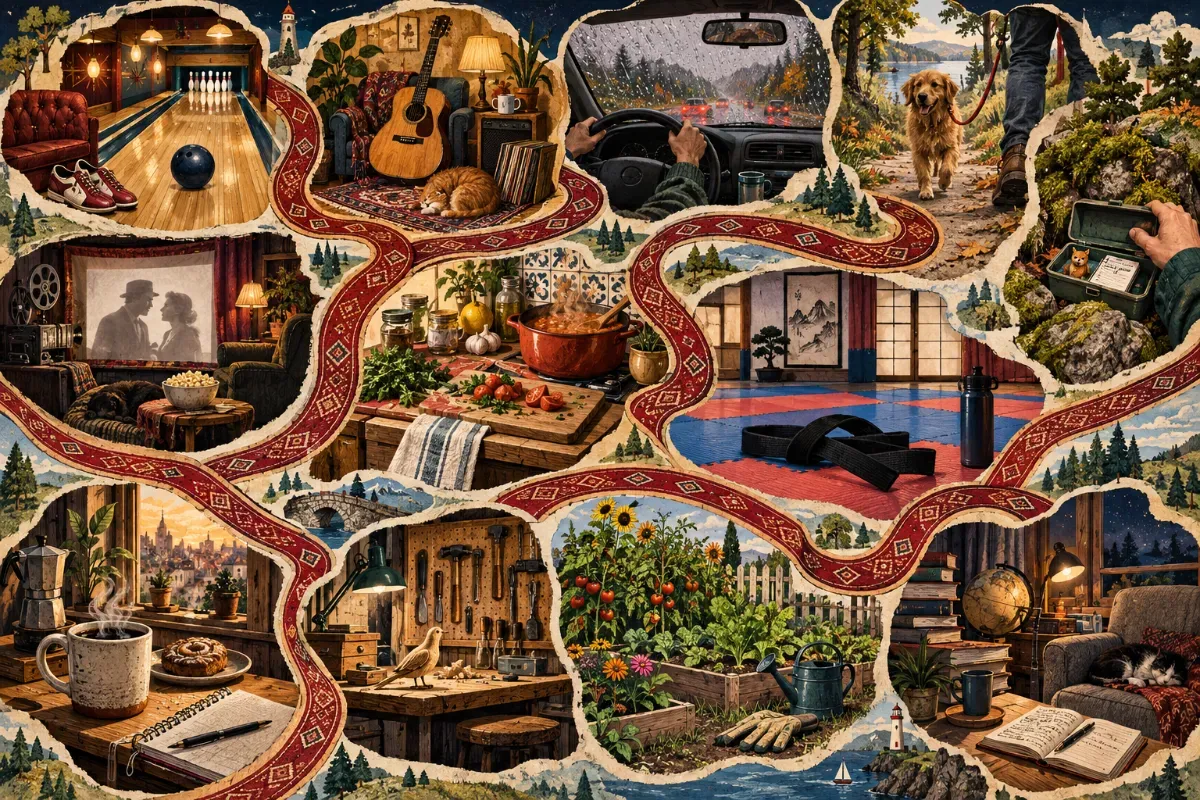
Because your bowling alley might not involve pins at all.
It might be guitar.
Geocaching.
Cooking.
Walking the dog.
Learning something new.
Martial arts.
Old films.
Gardening.
Model painting.
Gaming.
Photography.
A rainy drive.
Organizing a drawer because, for reasons known only to you and the gods of tiny domestic victories, it makes your brain feel better.
It might even be your work, if you are lucky enough to do something that feels aligned with your purpose.
For me, helping people and learning are both part of that. My career, my trainings, the constant curiosity about how people think, change, communicate, and become more themselves. That stuff is not just “work” to me. It is part of what keeps me interested in being here.
And that matters.
Ordinary joy is not a luxury item
There is a strange idea floating around that joy has to be earned.
As if you need to complete enough tasks, suffer enough, optimize enough, answer enough emails, become impressive enough, and prove you are responsible enough before you are allowed to enjoy something small.
That is exhausting.
It is also a bit daft.
Ordinary joy is not a luxury item.
It is not something you only get to have after everything else is handled.
Because everything else is never fully handled.
There is always another bill, another message, another chore, another worry, another plan, another person needing something, another bit of adulting crouched in the corner waiting to leap out and ask whether you remembered the thing you definitely did not remember.
If joy only comes after life is completely sorted, joy is going to be waiting a very long time.
This does not mean ignore your responsibilities.
It means stop treating ordinary enjoyment like a guilty pleasure when it might be one of the things helping you stay human enough to handle those responsibilities in the first place.
Joy broadens the room
There is research in positive psychology around what is called the broaden-and-build theory of positive emotions. The simple version is that emotions like joy, interest, contentment, and love can broaden the way people think and act, which can help them build resources over time: social, psychological, intellectual, and even physical resources.
That is a fancy research way of saying something very human:
When you feel better, you often see more.
More options.
More possibilities.
More connections.
More ways through.
More reasons to keep going.
Negative emotion tends to narrow the room. Sometimes that is useful. If a bear is chasing you, you do not need to pause and consider twelve creative interpretations of bear energy.
Run.
But when the threat is not a bear, and is instead life stress, disappointment, uncertainty, boredom, frustration, or another ordinary human mess, narrowing the room can make everything feel more impossible.
Joy can open the room again.
Not always dramatically.
Not like a musical number where the furniture starts dancing.
Sometimes it is simply that a good laugh loosens the grip. A hobby gives your mind another place to stand. A walk helps you come back clearer. A familiar song reminds you that this moment is not the whole story.
That is not fluff.
That is useful.
Without ordinary joy, people get weird
When people do not have ordinary joys, life can get very thin.
They may become more stressed.
More rigid.
More reactive.
More disconnected.
More numb.
More likely to check out.
More likely to treat every inconvenience like a major attack from the universe.
More likely to scroll, snack, drink, work, argue, buy, avoid, or overthink their way through the emptiness.
And I am not saying that with judgment.
People are trying to feel something.
Or stop feeling something.
Or get a break.
Or find a little relief.
The trouble is that relief and restoration are not always the same thing.
Some things give you relief for a moment and leave you more scattered afterward.
Other things restore you.
They bring you back.
They help you feel a little more alive, a little more yourself, a little less like you are being dragged behind your own schedule by a rope made of notifications.
Your bowling alley, whatever it is, should restore you more than it removes you.
That is the difference.
The hobby is not the problem. Hiding is.
A hobby can be healthy.
A hobby can also become a bunker.
Same activity. Different use.
Watching a film from childhood can be a beautiful little pocket of nostalgia.
Watching three entire seasons of something because you are avoiding your life, your feelings, your work, your conversation, or your bank account is probably not the same thing.
Playing guitar for an hour can bring you back to yourself.
Playing guitar all day because you are refusing to deal with something important might be less “creative flow” and more “avoidance with strings.”
Going for a drive in the rain can be grounding.
Driving around aimlessly for hours because you cannot bear to go home may be telling you something else.
Even work can be tricky here.
If your career gives you purpose, meaning, and satisfaction, wonderful.
If you use work to avoid every part of life that does not come with a task list, that may be a different conversation.
The activity is not the whole story.
The relationship you have with it matters.
Ask yourself:
Does this help me return to life?
Or does this help me disappear from life?
Does it leave me clearer?
Or foggier?
More myself?
Or further away?
There is no need to get weirdly strict about it.
You do not need to turn joy into a performance review.
But it is worth noticing.
Your bowling alley might be ordinary to everyone else
One of the nice things about ordinary joy is that it does not have to make sense to anyone else.
Someone else may not understand why a particular show comforts you.
Or why organizing tools calms you down.
Or why you like standing in the garage listening to rain.
Or why one food from childhood somehow improves your faith in humanity by eleven percent.
Or why finding a tiny hidden geocache in the woods feels like the universe gave you a secret handshake.
They do not have to get it.
It is not theirs.
Your bowling alley is not chosen by committee.
It does not need to be impressive, productive, spiritual, profitable, cinematic, or Instagrammable.
It just needs to do something useful inside you.
That is enough.
And sometimes the more ordinary it looks, the more important it actually is.
A person who gardens may be growing more than tomatoes.
A person who paints tiny models may be practicing patience, focus, and delight.
A person who games with friends may be keeping a social bond alive.
A person who cooks may be creating comfort, memory, and care.
A person who walks the dog may be getting movement, companionship, air, and a daily reminder that joy sometimes has paws and an alarming interest in squirrels.
A person who sings badly in the car may be regulating their mood, enjoying their body, and bothering absolutely no one except perhaps the dashboard.
That counts.
The Office, small rituals, and the strange power of ordinary places
One reason shows like The Office connect with people is that they make ordinary life feel weirdly meaningful.
It is not a glamorous setting.
It is desks, meetings, fluorescent lighting, awkward conversations, vending machines, birthdays in a conference room, and people trying to get through another day without completely losing the plot.
And somehow, inside all that ordinary nonsense, there is friendship, romance, boredom, ridiculousness, loyalty, irritation, and genuine human connection.
That is life.
A lot of meaning happens in places that do not look meaningful from the outside.
The break room.
The car.
The porch.
The bowling alley.
The training room.
The kitchen.
The route you drive every day.
The chair where you drink your coffee.
The place where you practice.
The bit of the house where the dog always appears the moment a snack is opened.
We tend to look for meaning in the dramatic moments, and yes, those matter.
But ordinary joy often lives in repetition.
The thing you return to.
The place that holds you.
The ritual that steadies you.
The people who make the boring parts less boring.
The small thing that keeps saying, “You are still here. There is still something good.”
Do not wait until life is perfect
This is where people get caught.
They wait for life to calm down before making room for joy.
But life is not a polite guest.
It does not always calm down on request.
So maybe the better move is not waiting for perfect conditions.
Maybe it is choosing one small ordinary joy on purpose this week.
Not as an escape.
Not as a reward for suffering.
Not as a big personal development project.
Just because it helps you feel more like yourself.
Pick something small.
Play one song.
Take the rainy drive.
Make the tea.
Walk the dog.
Watch the old film.
Practice the thing.
Cook the food.
Read the chapter.
Work on the hobby for twenty minutes.
Sit outside for five.
Do the tiny side quest.
Whatever your version is.
And while you do it, actually be there.
That is the part people miss.
Do not drink the coffee while mentally fighting tomorrow.
Do not walk the dog while rehearsing an argument from 2019.
Do not watch the film while scrolling a second screen full of nonsense.
Be in the thing for a moment.
Let it count.
Your bowling alley can change
You are allowed to outgrow things.
A lot of people hold onto hobbies, identities, and interests because they used to work, even after they no longer do.
That is normal.
But your bowling alley is allowed to change.
The thing that restored you ten years ago may not restore you now.
The hobby that once made you feel alive may now feel like obligation.
The group that once felt like belonging may now feel like a costume that does not fit.
That does not mean it was fake.
It means life moved.
You moved.
The room changed.
So let yourself notice.
What still brings you back?
What feels like joy, not duty?
What gives you energy instead of only taking it?
What makes you feel more present?
What helps you re-enter life with more patience, humor, curiosity, or steadiness?
Those are good clues.
Follow them.
Find the ordinary thing and give it room
You do not need to turn this into a quest with a dramatic soundtrack.
Although, honestly, a dramatic soundtrack can help when folding laundry.
Just notice what already works.
Notice what you keep returning to.
Notice what makes you smile before you have time to perform being sensible.
Notice what helps you soften.
Notice what gives you a little more room inside.
And maybe, over the next few days, one of those ordinary joys will present itself.
A song.
A show.
A hobby.
A person.
A dog.
A cup of something warm.
A place.
A purpose.
A small bit of life that quietly says, “Here. This still matters.”
When that happens, do not dismiss it.
Do not apologize for it.
Do not immediately ask whether it is productive enough.
Let it be good.
Let it be yours.
Find your bowling alley.
Then actually spend a little time there.